
Merchant City Medical Group offers surgical and non-surgical cosmetic procedures, from our state of the art clinics throughout the UK & Europe.

Medication

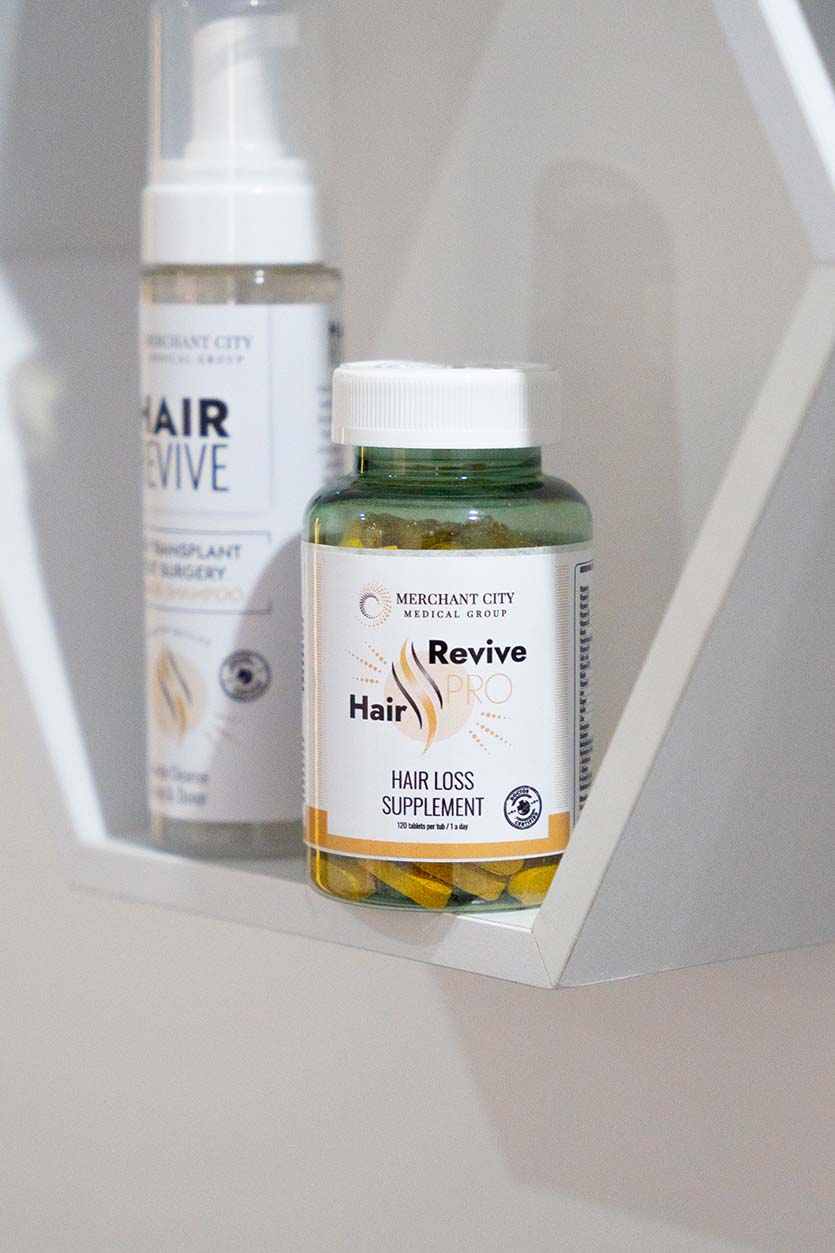
At Merchant City Medical Group, we offer evidence-based medical treatments for hair loss as part of a fully bespoke approach. Our experienced clinicians create tailored treatment plans designed to slow hair loss, preserve existing hair, and support long-term hair health, providing expert guidance throughout your journey.

Procedure overview

TYPE OF ANAESTHETIC

None

LENGTH OF SURGERY

30 Minutes

HOSPITAL STAY

No

RECOVERY

No downtime.

Procedure types

Minoxidil (Topical Treatment)

Minoxidil is a topical medication suitable for both male and female pattern hair loss. It has been clinically proven to slow hair loss and, in some cases, encourage regrowth—particularly at the crown (vertex) of the scalp. Topical Minoxidil was FDA approved for male pattern hair loss in 1988 and for female pattern hair loss in 1992. It is applied directly to the scalp and must be used daily to remain effective.
Regaine is the branded form of topical Minoxidil and is available over the counter in 2% and 5% strengths. Clinical evidence suggests that the 5% formulation is approximately 50% more effective than the 2% version. Results are typically most noticeable between 5 months and 2 years of consistent use. Minoxidil slows hair loss rather than stopping it entirely, meaning ongoing use is required to maintain results.

FDA-Approved Oral Medication (Finasteride)

Merchant City Medical Group clinicians may prescribe an FDA-approved oral medication that works by blocking the conversion of testosterone to dihydrotestosterone (DHT), the hormone responsible for male pattern baldness. This medication has been used safely in the UK for over 25 years. Studies show that after two years of use, approximately 83% of men either maintain their existing hair or experience regrowth. The medication works best in areas where hair is thinning rather than completely bald and is most effective when started early.

Our Approach

Tailored, Non-Surgical Care

Every patient begins with a detailed consultation to assess hair loss pattern, age, family history, and long-term goals. Medication may be recommended as a standalone treatment or combined with other options such as hair transplantation or mesotherapy. Our focus is on realistic expectations, long-term planning, and safe, clinically appropriate treatment.

Benefits

  • Clinically proven and FDA approved options
  • Slows or stabilises hair loss progression
  • Helps preserve existing hair
  • Improves hair quality and density in thinning areas
  • Non-surgical and easy to incorporate into daily routine
  • Strengthens hair follicles and increases follicle size
  • Non-surgical and easy to incorporate into daily routine
  • Can enhance and maintain hair transplant results
What are the risks?

Medical hair loss treatments are widely used and generally well tolerated. However, as with all medications, side effects are possible.

These effects are usually mild and often settle with continued use or adjustment:

  • Initial shedding when starting treatment

  • Scalp irritation (with topical Minoxidil)

  • Mild dryness or itching

Occur in a smaller percentage of patients:

  • Changes in hair texture

  • Temporary scalp redness

  • Mild headaches or dizziness

Rare but possible side effects will be fully discussed during consultation and may include:

  • Hormonal-related side effects (oral medication)

  • Allergic reactions

  • Persistent scalp irritation

Commonly Asked Questions

Most patients notice improvement after 3–6 months, with best results around 12 months.

Yes. Stopping treatment usually leads to a gradual return of hair loss.

No. Medication works best on thinning areas where hair follicles are still active.

Yes. Medication is often recommended to support and maintain transplant results.

Not always. A consultation is required to determine suitability.

What to Expect & Aftercare

  • Comprehensive consultation and assessment

  • Discussion of expectations and commitment required

  • Daily topical application or oral medication as advised

  • Regular monitoring of progress

  • Continued use required to maintain benefits

  • Follow-up appointments to review effectiveness

  • Adjustments made if necessary

Excellence Record

Merchant City Medical Group is proud to be one of the leading providers of Hair Transplant Surgeries and Medical Aesthetics within the UK and Europe. With our extensive team of expert surgeons, nurse practitioners and consultants, you will be met with the utmost dedication and compassion throughout your journey with us.

Book a Free Consultation

Enter all details and submit the form and we will get back to you.
I consent to being contacted via WhatsApp for appointment reminders, updates, and relevant information. Message Frequency varies based on the treatment. text: STOP to stop.

Cosmetic Procedure Screening Questionnaire

It can be used as a screening questionnaire to tell whether you might have BDD.

1) How often do you do you deliberately check your feature(s)? Not accidentally catch sight of it. Please include looking at your feature in a mirror or other reflective surfaces like a shop window or looking at it directly or feeling it with your fingers.
2) To what extent do you feel your feature(s) are currently ugly, unattractive or ‘not right’?
3) To what extent does your feature(s) currently cause you a lot of distress?
4) How often does your feature(s) currently lead you to avoid situations or activities?
5) To what extent does your feature(s) currently preoccupy you? That is, you think about it a lot and it is hard to stop thinking about it?
6) If you have a partner, to what extent does your feature(s) currently have an effect on your relationship with an existing partner? (e.g. affectionate feelings, number of arguments, enjoying activities together). If you do not have a partner, to what extent does your feature(s) currently have an effect on dating or developing a relationship?
7) To what extent does your feature(s) currently interfere with your ability to work or study, or your role as a homemaker? (Please rate this even if you are not working or studying: we are interested in your ability to work or study.)
8) To what extent does your feature(s) currently interfere with your social life? (with other people, e.g. parties, pubs, clubs, outings, visits, home entertainment)
9) To what extent, do you feel your appearance is the most important aspect of who you are?

Do I have BDD?

Body Dysmorphic Disorder

You have scored 0

When you score more than 40 points, this is an indication that you likely have Body Dysmorphic Disorder. However, this is not a formal diagnosis. This test can also be used after a treatment to see if symptoms have improved.

What now?

For more information on BDD and support, you can contact us.

If you are a UK resident, we suggest:

    • reaching out to your GP for more help
    • self-refer to NHS Talking Therapies.

When speaking to a health professional, you may present your clinic history or a printed form to clearly outline the symptoms you’ve experienced.